How to Introduce Solids: 7 Steps for an Easy Start

Those first messy meals look like chaos, but they are exactly how babies learn to eat.
The first time I set a tiny spoon of mashed avocado in front of my oldest, I had a camera in one hand, a bib in the other, and absolutely no idea what I was doing. She made a face like I had betrayed her, pushed most of it back out with her tongue, and smeared the rest into her eyebrows. I remember sitting there thinking, this cannot possibly be how it is supposed to go. It turns out that messy, confused, slightly comical first attempt is exactly how it is supposed to go. Learning how to introduce solids is less about getting food into your baby and more about letting your baby get comfortable with food.
I have now done this dance three times, with three very different little eaters, and I have also spent years on a pediatric ward watching families navigate this same milestone. What I have learned is that the families who relax the most are the ones who understand the rhythm of it: when to start, how to keep it safe, and how to let go of the pressure to hit some imaginary quota. In this guide I will walk you through seven simple steps, plus a clear safety section on choking versus gagging, so you can sit down at that first meal feeling calm and ready instead of frantically Googling between bites.
A quick word before we start: milk is still the main event
Before we get into the steps, hold onto one reassuring fact. For the entire first year, breast milk or formula remains your baby's primary source of nutrition. Those early spoonfuls of food are practice, exploration, and an introduction to new tastes and textures. They are not meant to replace milk feeds yet. There is a saying in the feeding world that I love: food before one is just for fun. It is a little oversimplified, but the spirit is exactly right. It takes the pressure off and reminds you that every bite is a bonus, not a requirement.
I wish someone had tattooed that on my arm with my first baby. I spent so many meals worrying about whether she ate enough, when the truth was that her milk was doing the heavy lifting and the food was just teaching her mouth and hands a brand new skill. Keep that in your back pocket as you read on, because it makes every single one of these steps easier.
Step 1: Know the readiness signs and the right timing
The number one question I get is some version of, "Is my baby ready?" The age guideline most pediatric groups agree on is around six months. Some babies show signs a little before, some a little after, and the calendar alone is not the whole story. Age is the starting point, but the real green light comes from your baby's body and behavior. I always tell friends to watch the baby, not just the date on the fridge.
There are four signs I look for, and I like to see most of them lining up before I bring out a spoon. The first is that your baby can sit up with support and hold their head steady and upright. A wobbly head and a slumped little body are not ready to manage food safely. The second is that the tongue-thrust reflex has faded. Newborns automatically push things out of their mouths with their tongue, which is protective, but it makes eating impossible until it calms down.
The third sign is genuine interest. You will know it when you see it. Your baby starts staring at your plate, leaning toward your fork, maybe even reaching for your sandwich and doing that hungry little open-mouth thing. The fourth is improving hand-eye coordination, those moments when they can grab a toy and bring it straight to their mouth. When you see a baby who can sit, hold their head up, has lost the tongue thrust, and is clearly fascinated by food, that is your moment.
Sarah's tip: Resist the urge to start solids early to help with sleep. I tried this with my first because a well-meaning relative swore by it, and it did nothing except make us both frustrated. If sleep is your worry, my newborn sleep tips will serve you far better than an early bowl of cereal ever will.
Step 2: Set up a safe, calm space
Where and how your baby sits matters more than people expect. The single most important rule is that your baby eats sitting upright, never reclined or in a bouncer or car seat. An upright position lets gravity help food travel safely down and gives your baby the stability to focus on the new job in front of them. A reclined baby cannot manage food well and is at higher risk of choking, so this is non-negotiable in my house.
This is where a proper high chair earns its keep. You want one with a supportive, upright back, a footrest if possible, and straps that keep your baby snug and centered. A baby whose feet dangle and whose body slides around will tire quickly and feel unsteady. If you are still shopping, I put together everything I look for in my guide to the best high chair picks, including the easy-clean features that will save your sanity once the real mess begins.
Beyond the chair, keep the environment calm. Turn off the television, put your own phone down, and sit at eye level with your baby. Mealtime is a sensory firehose for a new eater, and a quiet, focused setting helps them concentrate on learning. I always made sure I was sitting right there at the table, never walking away or multitasking, both for safety and because babies learn to eat by watching us eat.
Step 3: Choose first foods wisely
There is no single official first food anymore, which is wonderfully freeing. For years everyone defaulted to rice cereal, but current guidance is more flexible and, honestly, more interesting. The two qualities I prioritize for early foods are iron content and simplicity. Babies are born with iron stores that start running low around six months, right when solids begin, so iron-rich foods are a smart and meaningful place to start.
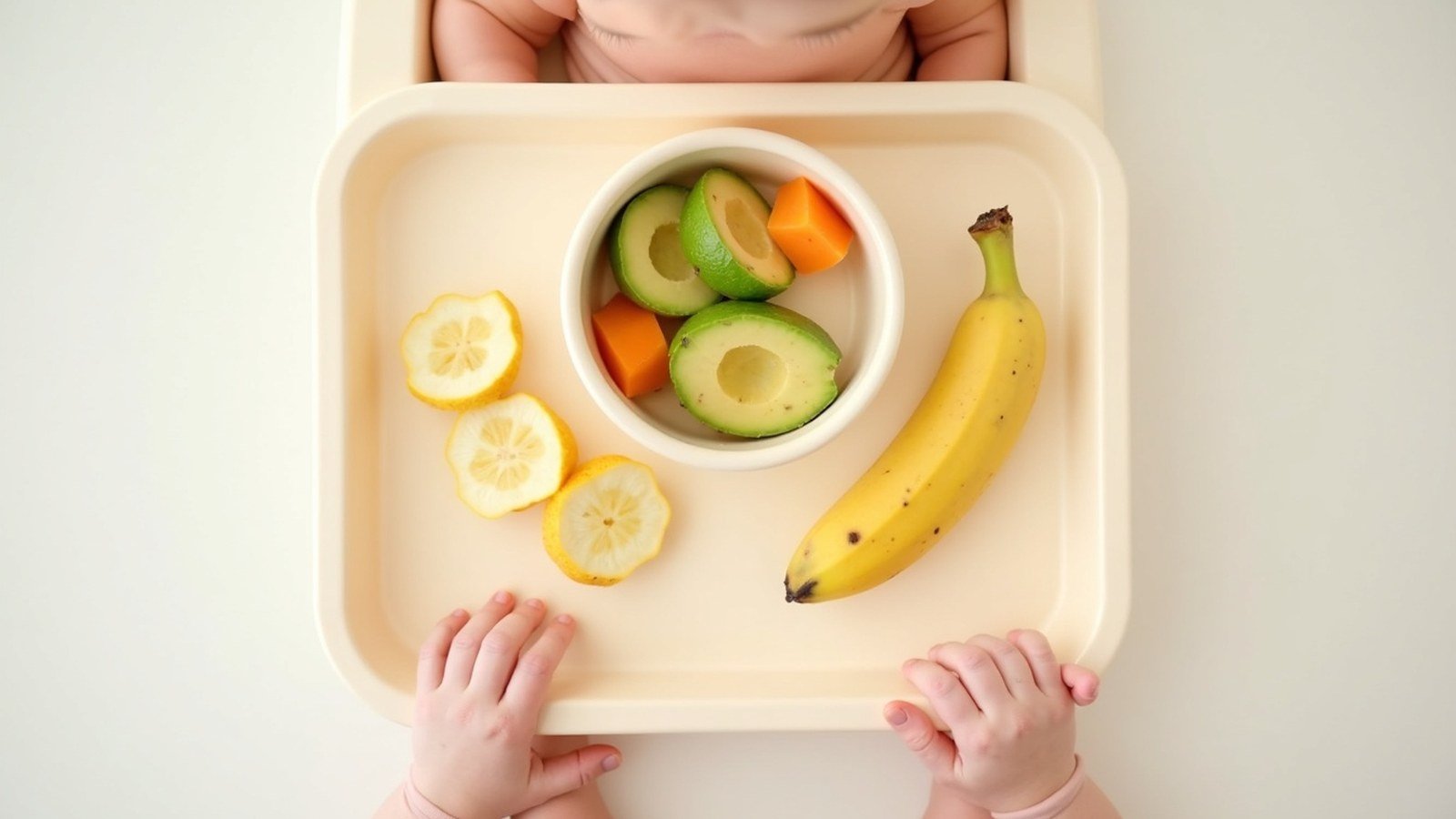
Great iron-rich options include well-cooked and mashed meats, poultry, lentils, beans, tofu, and iron-fortified infant cereals mixed to a smooth consistency. I also love soft cooked vegetables like sweet potato, butternut squash, peas, and avocado, which is technically a fruit but behaves like the perfect creamy starter food. Soft fruits such as ripe banana, cooked apple, and pear round things out nicely. The American Academy of Pediatrics has a helpful overview of starting solid foods on HealthyChildren.org if you want the official nutritional breakdown.
The other principle is to introduce single ingredients at a time, at least in the beginning. When you offer just one new food and wait a couple of days before adding another, you can spot any reaction and know exactly what caused it. It also lets your baby get to know each flavor on its own. There is plenty of time for elaborate combinations later. In these first weeks, simple is both safer and easier on everyone.
Step 4: Start small and learn the difference between texture and trouble
Begin with genuinely tiny amounts. We are talking a teaspoon or two at a meal, once a day, slowly working up as your baby shows interest. Their stomach is the size of their little fist, so a "full meal" by adult standards is wildly more than they need. I always started with one short session, usually mid-morning when my babies were alert and cheerful but not ravenous, because a starving baby has no patience for learning something new.
Texture is where a lot of parents get nervous, so let me reassure you. Whether you choose smooth purees, soft mashed foods, or appropriately sized finger foods, your baby will gag at some point, and that is completely normal. Gagging is a loud, dramatic, protective reflex that moves food forward and away from the airway. It looks alarming, but it is your baby's body working exactly as designed. I cover the choking-versus-gagging distinction in detail in the safety section below, because it is that important.
If you are drawn to skipping purees and going straight to soft finger foods, that approach has its own name and its own set of rules. I walk through it fully in my baby-led weaning guide, which pairs beautifully with everything here. Many families, mine included, end up doing a blend of spoon-feeding and finger foods, and that is perfectly fine. There is no prize for purity. The goal is a confident, happy eater, however you get there.
Step 5: Introduce common allergens early and safely
This is the step that has changed the most since I had my first baby, and it is worth paying attention to. For years parents were told to delay allergens like peanuts and eggs. The current guidance has flipped: introducing common allergens early, generally once solids are underway and going well, may actually help reduce the risk of developing a food allergy. That was a genuine relief to read, because the old approach made many of us anxious and overly cautious.
The common allergens to introduce intentionally include peanut, egg, dairy, soy, wheat, tree nuts, fish, shellfish, and sesame. Offer them in a safe, age-appropriate form. That means smooth peanut butter thinned with water or mixed into a puree rather than a spoonful of sticky paste, well-cooked egg, and a little plain yogurt. Whole nuts and globs of nut butter are choking hazards and should be avoided, so always adapt the texture.
The practical method is simple. Introduce one allergen at a time, ideally earlier in the day rather than right before bed, so you can watch your baby for the next couple of hours. Most reactions are mild, things like a few hives or some redness around the mouth. Serious reactions are rare but real, so if you ever see swelling of the face or lips, difficulty breathing, or repeated vomiting, treat it as an emergency and call for help. If your baby has eczema or a known family history of allergies, talk to your pediatrician before you begin, because they may recommend a specific approach.
Step 6: Build variety and an easy rhythm
Once your baby has tried a handful of foods without trouble, the fun really begins. This is the stage where you start widening the menu and gently building solids into the shape of the day. There is no need to rush. Over the weeks following that first meal, you gradually move from one small session to two, and eventually three, until food slots naturally alongside milk feeds. I never forced this. I simply followed my babies' growing appetite and interest.
Variety is your friend here, and not just for nutrition. The more flavors and textures a baby meets early, the more accepting they tend to be later, which can spare you a world of toddler pickiness. So rotate colors, tastes, and textures. Offer savory as well as sweet, because babies do not need everything to taste like fruit. Herbs and mild spices are welcome too. I added cinnamon, cumin, and herbs early, and I genuinely believe it helped my kids become adventurous eaters.
As food becomes a regular part of the day, it helps to think about how it fits with everything else. A predictable flow of milk, food, naps, and play makes for a smoother baby and a calmer parent. If you want a framework, my baby feeding schedule guide lays out how meals and milk can fit together month by month, so you are not guessing at every turn. Use it as a loose map, not a rigid timetable, and adjust to your real baby.
Step 7: Keep mealtimes pressure-free
If you take only one thing from this entire guide, let it be this step. Your job is to offer good food in a safe setting. Your baby's job is to decide whether and how much to eat. That division of responsibility sounds simple, but it is the secret to raising a relaxed eater, and it is the rule I see broken most often by loving, well-meaning parents who just want their child to eat.
Never force, bribe, trick, or play airplane to push in one more bite. I know the urge, believe me, especially on the days when almost nothing goes in. But pressure backfires. It teaches babies to associate eating with stress, and it can actually create the picky behavior you are trying to avoid. Some days your baby will eat with gusto, and some days they will turn their head away after two bites. Both are normal. Appetite swings wildly with growth spurts, teething, and mood.
Instead, make mealtimes pleasant and social. Eat together when you can, let your baby get messy, narrate what you are doing, and smile. Trust that over a week, not a single meal, your baby will balance out their intake remarkably well. When you stay calm and consistent, you are teaching something far more valuable than how to finish a bowl. You are teaching your child that eating is a happy, no-pressure part of being together.
Safety first: choking versus gagging, and foods to avoid
I saved the most important section for the spot where you will remember it. Understanding the difference between gagging and choking will lower your anxiety more than anything else, because the two look and sound completely different once you know what to watch for. Before your baby's first meal, I strongly recommend learning infant first aid and basic choking response. Confidence comes from preparation, and a short class is worth every minute.
Gagging is loud and normal
Gagging is noisy. Your baby will cough, sputter, make dramatic faces, maybe go a little red, and push the food forward and out. It is a protective reflex doing its job, and it is part of how babies learn to manage food. As hard as it is, the best thing you can do during a gag is stay calm and let them work it out. Swooping in and sticking your fingers in their mouth can actually push food further back. Watch, stay close, and let the reflex do its work.
Choking is silent and serious
Choking, by contrast, is frighteningly quiet. A truly choking baby cannot make noise because air cannot move. You may see silent distress, a panicked expression, a high-pitched or absent sound, or a color change to blue around the lips. This is when you act immediately with infant back blows and chest thrusts and call emergency services. This is exactly why your baby should always be supervised, upright, and within arm's reach during every single meal. Never prop a bottle or leave food with an unattended baby.
Foods to avoid in the first year
A few foods deserve a firm no, and it helps to know them up front. Honey is off the menu entirely until after the first birthday because it can carry spores that cause infant botulism, a serious illness. Then there are the classic choking hazards, which should be avoided or carefully modified: whole nuts, large globs of nut butter, whole grapes, cherry tomatoes, popcorn, hard or raw vegetables like raw carrot, hot dogs and sausage in round coin shapes, chunks of hard cheese, hard candy, and marshmallows.
The good news is that many of these become safe with a simple modification. Grapes and cherry tomatoes can be quartered lengthwise. Hot dogs can be cut into thin strips rather than coins. Hard vegetables can be cooked until soft. Nut butter can be thinned and spread thinly. You are not banning whole food groups forever, just shaping them into forms a new eater can handle. For another trustworthy reference on safe weaning, the NHS has a clear, practical guide at the NHS Start for Life weaning pages that I often share with parents.
Frequently asked questions about introducing solids
How much should my baby actually eat at first?
Far less than you probably imagine. In the beginning, a teaspoon or two at a single daily session is plenty, and some days your baby will take even less, or refuse entirely. Remember that those early meals are practice, and milk is still covering their nutritional needs for the whole first year. Follow your baby's cues. When they turn their head, close their mouth, or lose interest, the meal is over. There is no quota to hit, and your baby is genuinely better than you are at knowing when they are full.
Should I start with purees or finger foods?
Either approach works, and so does a mix of both. Spoon-fed purees give you a sense of control and are easy to start with, while soft finger foods let your baby explore texture and self-feeding from day one. Many families combine them, offering some spoonfuls alongside soft pieces baby can grab. The only firm rules are that food must be an appropriate soft texture and size, and your baby must be sitting upright and supervised. Choose the style that feels right for your family and your baby's temperament. There is no single correct path.
What if my baby gags every single time?
Frequent gagging in the early weeks is normal and usually fades as your baby gets the hang of moving food around their mouth. Gagging is the protective reflex working, not a sign of danger, as long as it is the loud, sputtering kind rather than silent distress. Stay calm, keep meals upright and supervised, and offer textures suited to your baby's stage. If the gagging seems extreme, comes with real distress, or never improves over time, mention it to your pediatrician so they can rule out any underlying feeding issue and put your mind at ease.
Do I need to delay allergens like peanut and egg?
Current guidance has moved away from delaying allergens. For most babies, introducing common allergens early, once solids are underway and going smoothly, may actually help reduce the risk of developing a food allergy. Offer them one at a time in a safe, age-appropriate texture, earlier in the day so you can watch for any reaction. If your baby has significant eczema, an existing food allergy, or a strong family history, speak with your pediatrician first, because they may want to guide the timing and approach for your particular situation.
Can introducing solids help my baby sleep through the night?
It is a popular hope, but the evidence does not really support it, and I learned that the hard way with my first. Starting solids before your baby is developmentally ready will not buy you longer nights, and it can cause frustration and tummy upset instead. Night waking in the first year is usually about development, not hunger for food. If sleep is your real concern, gentle routines and realistic expectations will help far more. My newborn sleep tips are a much better starting point than an early bowl of cereal.
How do I keep mealtimes from becoming a battle?
The trick is to drop the goal of getting food in and replace it with the goal of a pleasant shared meal. You provide safe, healthy food in an upright, calm setting, and you let your baby decide how much to eat. No forcing, no bribing, no airplane spoons. Let them be messy, eat alongside them when you can, and trust their appetite over the span of a week rather than a single meal. Babies are wired to regulate their own intake, and the calmer you stay, the more relaxed and adventurous an eater they tend to become.
Final thoughts: trust the process and enjoy the mess
Starting solids is one of those milestones that feels enormous in the moment and then, somehow, becomes a regular part of your day before you even notice the shift. If you watch for the readiness signs, set up a safe upright space, choose simple iron-rich first foods, start small, introduce allergens thoughtfully, build variety, and keep the whole thing pressure-free, you have already done the important work. The rest is just practice, patience, and a great many wet washcloths. Your baby does not need a perfect meal. They need a calm parent, a safe setting, and the freedom to learn at their own pace.
So take a deep breath and let yourself enjoy this. The avocado eyebrows, the suspicious first faces, the triumphant moment they finally figure out how to chew, these are the memories you will look back on and laugh about. You clearly care deeply about doing this well, or you would not have read all the way to the end. Trust yourself. When you are ready for the next chapter, browse the related guides below, and please send me a note to tell me how that first meal went. I read every message and I would genuinely love to hear about it.